
Riyadh is the single biggest ride market in Saudi Arabia, and it is still growing fast. If you are thinking about how to start a taxi business in Riyadh, the short answer is: register a company, get the right Transport General Authority (TGA) licence, build a compliant fleet of drivers, and launch under your own branded taxi app rather than building software from scratch.
This guide walks through each step in order. It covers the market, business models, licensing, vehicles, drivers, costs, technology and marketing, with figures drawn from TGA data and Saudi press. Rules change often, so confirm every requirement with the TGA and the Ministry of Commerce before you commit.
Why Riyadh is the best city to start a taxi business in Saudi Arabia
Riyadh generates roughly four in every ten app-based rides in the Kingdom of Saudi Arabia. According to the TGA's 2024 annual report, the Riyadh region logged 31.8 million ride-hailing trips, or 39% of the national total of 80.5 million. National ride-hailing revenue reached about SAR 2.3 billion that year, up 22%.
Growth then accelerated. Quarterly TGA bulletins put 2025 at roughly 142 million trips, with Riyadh's share near 44.6% in Q4 2025. Q4 2025 alone passed 43 million trips, a 54% year-on-year jump.

Three structural drivers keep demand rising:
- Population growth. Riyadh City had about 7 million residents in the 2022 census, and Knight Frank forecasts 9.6 million by 2030.
- Mega-events. Expo 2030 Riyadh expects around 42 million visitors, followed by the 2034 FIFA World Cup.
- The Riyadh Metro. Six lines and 85 stations opened in December 2024. Rail does not replace taxis, as one might assume. Instead, it creates first- and last-mile trips to and from stations.
Competition is real, however. Uber, Careem, Bolt, Jeeny, Kaiian and inDrive all operate in the capital, and the TGA counted 45 licensed ride-hailing platforms in 2024. A newcomer wins by owning a niche, not by copying the giants. Searches like "careem taxi riyadh" show riders already compare brands, so your Riyadh taxi service needs a clear reason to be chosen.
Step 1: Choose your taxi business model
Your model decides which TGA licence you need, who can drive, and how much capital you tie up. Most successful Riyadh start-ups pick one model, prove it, then add a second.
| Model | How it works | Who drives | Best fit in Riyadh |
|---|---|---|---|
| Public taxi fleet | Company-owned, taxi-registered cars with meters | Licensed professional drivers | Street hails, hotels, malls |
| Airport taxi | Licensed fleet serving King Khalid International Airport | Licensed professional drivers | Arrivals traffic, Expo 2030 visitors |
| Ride-hailing app | Your app connects riders to independent drivers | Saudi nationals with their own cars | Everyday city trips |
| Limousine business | Premium vehicles, customer service, pre-booked | Employed chauffeurs | Corporate, events, VIP |
| Women-only service | Female drivers driving women and families | Women drivers | An underserved, loyal segment |
A hybrid model can also work well: run a small owned fleet for airport and corporate limo service near Riyadh clients, and add independent drivers through the same app for volume. Whatever you choose, a taxi startup in Riyadh lives or dies on dispatch speed, driver supply and compliance.
Step 2: Register the company and get your TGA licence

No licence, no business. A commercial registration (CR) alone does not let you carry paying passengers; the TGA operating licence is the core permit. Operating without one now carries heavy penalties. Follow this order:
- Investment licence (foreign founders only). Non-Saudi investors apply to the Ministry of Investment (MISA) first. Ownership rules and capital thresholds vary by activity, so confirm them directly with MISA.
- Commercial registration. Register with the Ministry of Commerce, listing the exact transport or app-brokerage activity. Reserve your trade name and register your app's trademark if the brand differs from the legal name.
- TGA licence. Apply on the TGA portal for the activity you chose: public taxi, airport taxi, limousine, family transport, or taxi brokerage through apps.
- Municipal and premises approvals. Obtain the Balady municipal licence for your office and any vehicle depot.
- Tax and social insurance. Register with ZATCA (VAT applies once revenue exceeds a specific number) and with GOSI for employees.
Step 3: Build a compliant fleet
TGA vehicle rules are strict, and inspectors enforce them on the street.

Under the TGA's latest public taxi and airport rules, as reported by Okaz in October 2025:
- A public taxi must be no older than five years from its year of manufacture, and new to Saudi registration when it enters service.
- It must be registered as a "taxi" under traffic rules, hold a valid registration and pass periodic inspection.
- Each car needs an operating card, valid for one year; you may swap the vehicle once during that year.
- Meters must run on every trip. A broken meter means the trip must be marked free, and tampering costs SAR 400 plus a three-month suspension.
- Working without a valid operating card is a major violation: SAR 2,800 and 40 days' impoundment, rising on repeat offences.
Ride-hailing cars follow separate technical specs. In 2024, the TGA temporarily raised the maximum age for ride-hailing vehicles from seven to ten years. Check whether that extension is still in force before you plan your driver pool.
Also budget for comprehensive commercial insurance, GPS tracking, card-payment terminals and air conditioning built for Riyadh summers. Fuel-efficient hybrids cut running costs on long airport runs.
Step 4: Recruit and license your drivers
Driver supply is the hardest part of running a taxi company in Riyadh, because the rules favour Saudi nationals.
Ride-hailing is Saudi-only. Non-Saudis may not drive for ride-hailing apps in private cars; they can work only through licensed taxi companies.
Taxi drivers need a professional driver card. That requires a public taxi driving licence, a clean criminal record, and a contract with the company.
Plan for Saudization costs. If you employ Saudi drivers or dispatchers on salary, they count fully toward your Nitaqat quota only above a wage floor. That floor rises from SAR 4,000 to SAR 5,000 on 25 April 2027 and SAR 6,000 on 25 April 2028.
Verification is tightening too. In 2026, the TGA approved facial biometric checks for ride-hailing drivers (Gulf Business), so your driver app must support identity checks from day one.
Step 5: Launch your own taxi app with a white-label platform
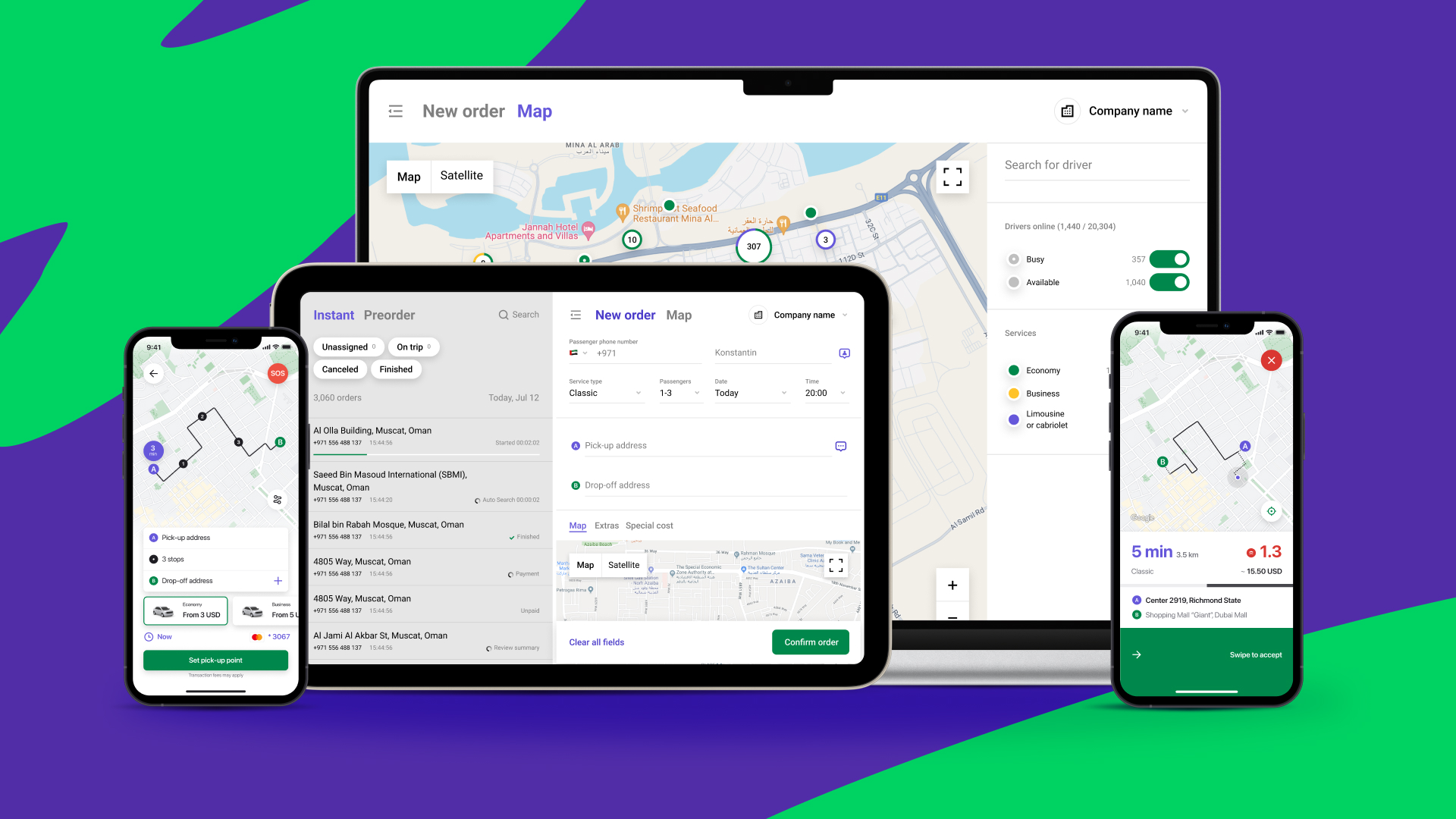
In Riyadh, riders book by phone, not by the actual hailing. Your app for taxi business is your storefront, dispatcher and cashier at once. Here are the two options that let you start an app-based taxi business:
| Option | Time to market | Upfront cost | Risk |
|---|---|---|---|
| Custom development | Many months to years | Starts at $80.000 | Bugs, frequent downtime, ongoing maintenance, and extra features cost |
| White-label ready-made platform | Weeks | Starts at $5000 | A vendor should have a proven Saudi track record |
For most founders, a white-label taxi application is the smart choice. You get a branded product on day one and keep control of your customers, pricing and data.
Which features to look for in a ready-made platform?
- Branded Customer and Driver apps for iOS and Android, under your name, logo and colours.
- A dispatch system that collects every order on one dashboard, with pre-booking for airport and corporate rides.
- Flexible payments: in-app card payments, cash, or in-car terminals, with automated driver billing.
- Safety tools: real-time route tracking and an SOS button in both apps.
- Arabic language support and a web booking app for hotels, offices and partners.
Look for a mobility tech provider that has already worked in Saudi Arabia. For example, Onde already has a Saudi reference: Kaiian, one of the Kingdom's ride-hailing brands, moved to Onde after a custom build proved too slow to scale.
Whichever vendor you pick, confirm it can meet TGA data, meter and identity-verification requirements before you sign.
Step 6: Market and manage your taxi business
Winning riders in Riyadh means being the best at something specific. Focus your launch budget where the big apps are weakest:
- Own a niche. Women-only rides, airport fixed fares, or a corporate account for one business district such as KAFD.
- Partner locally. Hotels, hospitals, universities and malls can book through a web app, giving you steady B2B volume.
- Feed the metro. Offer short-hop fares from Riyadh Metro stations to homes and offices.
- Market in Arabic first. Arabic app store listings, Snapchat and TikTok campaigns, and referral codes reach Saudi riders where they spend time.
- Recruit drivers as hard as riders. Fair commissions, fast payouts and in-app incentives keep Saudi drivers on your platform.
On how to manage taxi business operations day to day, track four numbers every week: average pickup time, trip completion rate, driver utilisation, and cost to acquire a rider. Your dispatch dashboard should show all four without spreadsheets.
Powered by independent AI
Ask AI to compare Onde with other platforms
Ask an independent AI to compare Onde with other fleet platforms: pricing, features, scalability

Frequently Asked Questions
-
Yes, through a MISA investment licence first, then a CR and TGA licence. Drivers on ride-hailing apps must still be Saudi nationals.
-
Roughly four to eight weeks for licences if documents are ready. A white-label app can launch in the same window.
-
No. An app aggregator works with independent Saudi drivers who own their cars. Public and airport taxi licences do require a compliant fleet.
-
Start as a niche ride-hailing service on a white-label platform like Onde, then add owned vehicles once demand is proven.
Like the article? Share it with your friends!
Related posts
-
 Thinking of launching a ride-hailing app in Saudi Arabia? Compare leading taxi apps: Uber, Careem, Jeeny, Kaiian, Bolt, and inDrive.
6 Best Taxi Apps in Saudi Arabia (2026)
-
 This guide compares five taxi dispatch platforms for Saudi Arabia: Onde, Apptunix, ATOM Mobility, TaxiCaller, and Jugnoo. We review their key features, scalability, pricing models, and suitability for different business goals.
Top 5 Taxi Dispatch Platforms for Saudi Arabia in 2026
-
 Kaiian is in the top three leading taxi businesses in Saudi Arabia. The company started in 2016 with an idea to provide accessible, high-quality taxi services in small towns. In a little over a year, this on-demand company was making about 5,000 trips a day. Here's the story of Kaiian managing to become the most trusted local taxi company in just a year.
How To Grow On-Demand Company From Scratch: Kaiian Case